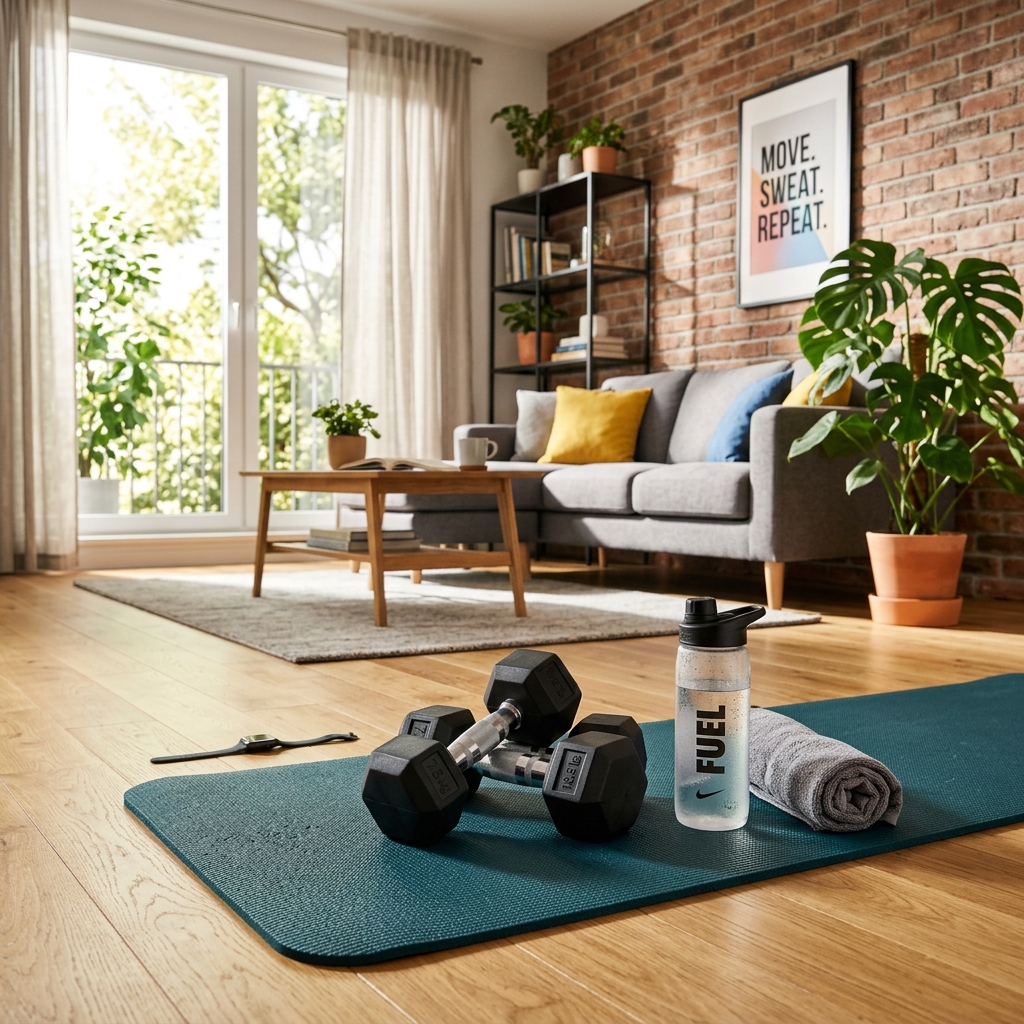
The idea of home workouts seems simple until you try to start. You open YouTube, find dozens of programs, each promising results in two weeks, but none explaining why exactly these exercises, in what order, and how many times. In the end, you do twenty push-ups, thirty squats, feel like a hero, and the next day you can't get out of bed and decide that home workouts are not for you.
In fact, working out at home without equipment is a complete system that, with the right approach, develops strength, endurance, and flexibility no worse than a gym. In this guide, we will break down everything: from warm-up to cool-down, from specific exercises to a weekly program. No dumbbells, pull-up bars, or memberships — just your body and a little free space.
Why you should work out at home
Home workouts have several non-obvious advantages that are often underestimated. First and most important is the lack of a barrier to entry. You don't need to commute to the gym, change in the locker room, or wait for a machine to become available. You just get off the couch and start.
The second advantage is savings. A gym membership costs a significant amount per month. A home workout is free. Third is privacy. Many people are embarrassed to exercise in front of experienced athletes.
Warm-up: five minutes that change everything
Warming up is not a formality or a waste of time. It is preparing the body for the load: increasing muscle temperature, increasing joint mobility, activating the nervous system. Without a warm-up, you not only increase the risk of injury but also reduce the effectiveness of the workout.
The warm-up should take five to seven minutes and include movements that gradually increase your heart rate and engage all major joints. Start with walking in place for one minute, gradually raising your knees higher. Then perform circular arm rotations forward and backward.
Basic exercises: an arsenal without equipment
The whole variety of home bodyweight exercises is built around a few basic movements. Each of them involves several muscle groups simultaneously, making the workout effective even with limited time.
Push-ups
Push-ups are perhaps the most versatile bodyweight exercise. They develop the pectoral muscles, front delts, and triceps, and with proper technique, they also strengthen the core muscles.
If classic push-ups are still too difficult, start with push-ups from the wall or from an elevation — a chair, sofa, or windowsill. The higher the support, the easier it is.
Squats
Squats are the king of exercises for the lower body. They work the quadriceps, glutes, hamstrings, and core muscles.
Plank
The plank is an isometric exercise that strengthens the deep core muscles, spine stabilizers, shoulder girdle, and even legs. It teaches the body to work as a single unit.
Lunges
Lunges develop the same muscles as squats but with an important addition: they train balance and coordination because the work is done on one leg.
Glute bridge
The glute bridge is an indispensable exercise for those who spend a lot of time sitting. It specifically activates the gluteal muscles.
"The best workout is the one you actually do. Not the perfect program on paper, but thirty minutes of movement that fits into your day."
How to create a weekly program
For beginners, the optimal regimen is three workouts a week, every other day. This provides enough load for progress and leaves time for recovery.
An approximate structure of a weekly program for a beginner might look like this. Monday: full body workout — push-ups (3 sets of 8-12 reps), squats (3 sets of 15), plank (3 sets of 20-30 seconds), glute bridge (3 sets of 15).
The principle of progression: how not to get stuck
The body adapts to the load in two to four weeks. If you do the same number of repetitions with the same technique every time, progress slows down and then stops. To avoid this, progressive overload is needed.
Cool-down and stretching
After a workout, do not immediately throw yourself on the couch. A cool-down helps to smoothly lower the heart rate, start the recovery process, and reduce muscle soreness the next day.
Typical beginner mistakes
The first and most common mistake is trying to do too much at once. The second mistake is neglecting technique for the sake of quantity. The third mistake is irregularity. The fourth mistake is holding your breath.
Summary
A home workout without equipment is not a compromise or a half-measure. It is a full-fledged tool for developing strength, endurance, and health, available to everyone. Push-ups, squats, lunges, plank, and glute bridge — these five exercises, when used correctly, can transform your body in a few months.